
Yagiz Alp Aksoy Clinician researcher
Caricature of Yagiz Alp Aksoy in the bench

The bench

Where I started: a PhD on light-activated gene delivery and CRISPR genome editing, at Macquarie University and the Garvan Institute.

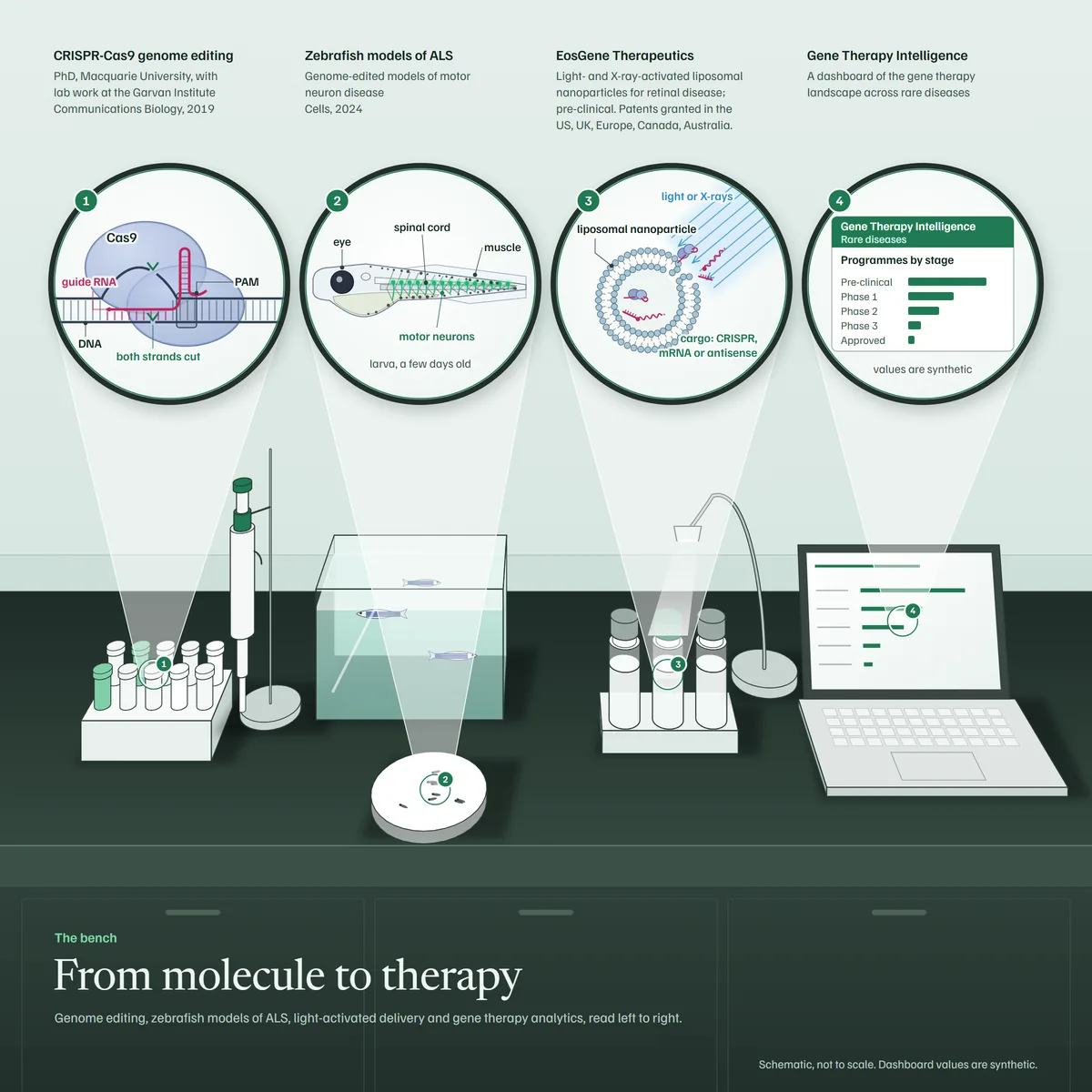
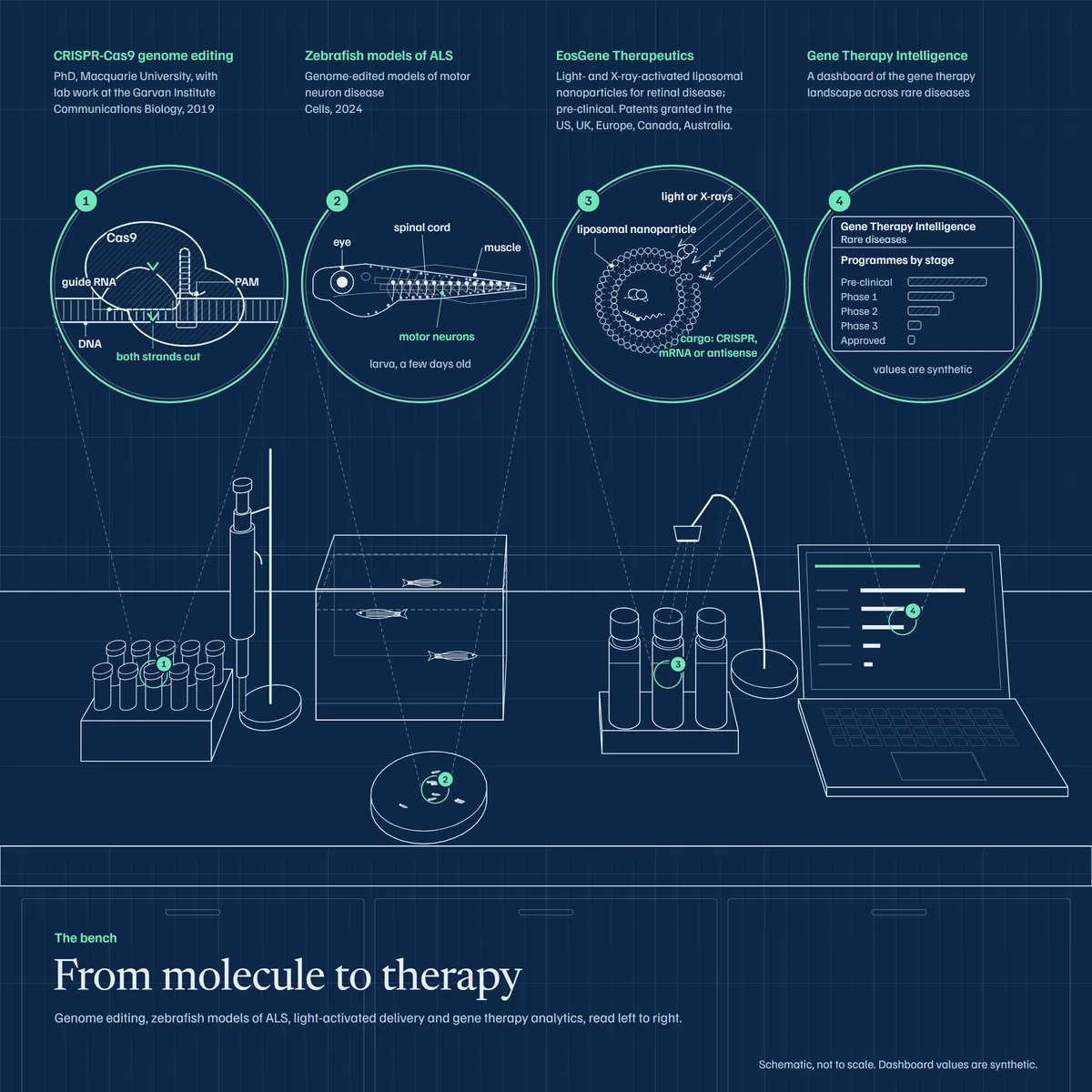
This bench holds my laboratory research in genome editing and gene delivery. The first two objects come from my PhD, the third is a company I co-founded in gene and drug delivery, and the fourth is a dashboard of the gene therapy landscape that I built.

The bench, illustrated. Every object is described below the picture.The bench, illustrated. Every object is described below the picture.

Move across the picture to look closer. On a phone, tap to place the lens.

CRISPR-Cas9 genome editing

My PhD was at Macquarie University, with lab work at the Garvan Institute, on CRISPR-Cas9 genome editing and light-activated gene delivery. As first author I reported that chemical reprogramming enhances homology-directed genome editing in zebrafish embryos, and described a light-triggered liposome system that controls where and when CRISPR-Cas9 edits genes. My first-author review sets out approaches to enhance precise CRISPR-Cas9 genome editing.

Everything in this room

CRISPR-Cas9 genome editing
My PhD was at Macquarie University, with lab work at the Garvan Institute, on CRISPR-Cas9 genome editing and light-activated gene delivery. As first author I reported that chemical reprogramming enhances homology-directed genome editing in zebrafish embryos, and described a light-triggered liposome system that controls where and when CRISPR-Cas9 edits genes. My first-author review sets out approaches to enhance precise CRISPR-Cas9 genome editing.Communications Biology, 2019ACS Applied Materials & Interfaces, 2020International Journal of Molecular Sciences, 2021
Zebrafish models of ALS
My PhD also used genome editing to make zebrafish models of ALS, a form of motor neuron disease. As first author I reviewed the roles of FUS and TDP-43 in ALS, and reported that zebrafish CCNF and FUS mediate stress-specific motor responses.International Journal of Biochemistry & Cell Biology, 2020Cells, 2024
EosGene Therapeutics
I co-founded EosGene Therapeutics to translate nanoparticle delivery science. Its liposomal nanoparticles (LNPs) are designed for retinal disease: they release a cargo of CRISPR, mRNA or antisense when activated by light or X-rays, and the work is pre-clinical. The delivery platform is patented: two patent families are granted, the first in the US, UK, Europe, Canada and Australia, and the second in Australia. The company's side of the story is in the workshop.The workshop
Gene Therapy Intelligence
Gene Therapy Intelligence is a dashboard I built of the gene therapy landscape across rare diseases. It sets out gene therapy programmes by stage, from pre-clinical to approved; the values on its screen in the picture are synthetic.

In the picture

Title

The bench
From molecule to therapy
Genome editing, zebrafish models of ALS, light-activated delivery and gene therapy analytics, read left to right.
CRISPR-Cas9 genome editing
PhD, Macquarie University, with lab work at the Garvan Institute
Communications Biology, 2019
Zebrafish models of ALS
Genome-edited models of motor neuron disease
Cells, 2024
EosGene Therapeutics
Light- and X-ray-activated liposomal nanoparticles for retinal disease; pre-clinical. Patents granted in the US, UK, Europe, Canada, Australia.
Gene Therapy Intelligence
A dashboard of the gene therapy landscape across rare diseases
larva, a few days old
liposomal nanoparticle
light or X-rays
cargo: CRISPR, mRNA or antisense
Rare diseases
Programmes by stage
Pre-clinical
Phase 1
Phase 2
Phase 3
Approved

values are synthetic

Schematic, not to scale. Dashboard values are synthetic.