
Yagiz Alp Aksoy Clinician researcher
Caricature of Yagiz Alp Aksoy in the lab

The lab

The Aksoy Laboratory for Clinical and Translational AI at the Centenary Institute.

A clinical AI project has four jobs: build the model, validate it in new populations, deploy it in a real workflow, and govern it once it is in use. In my experience many projects stop after the first; the lab’s research concerns the other three.

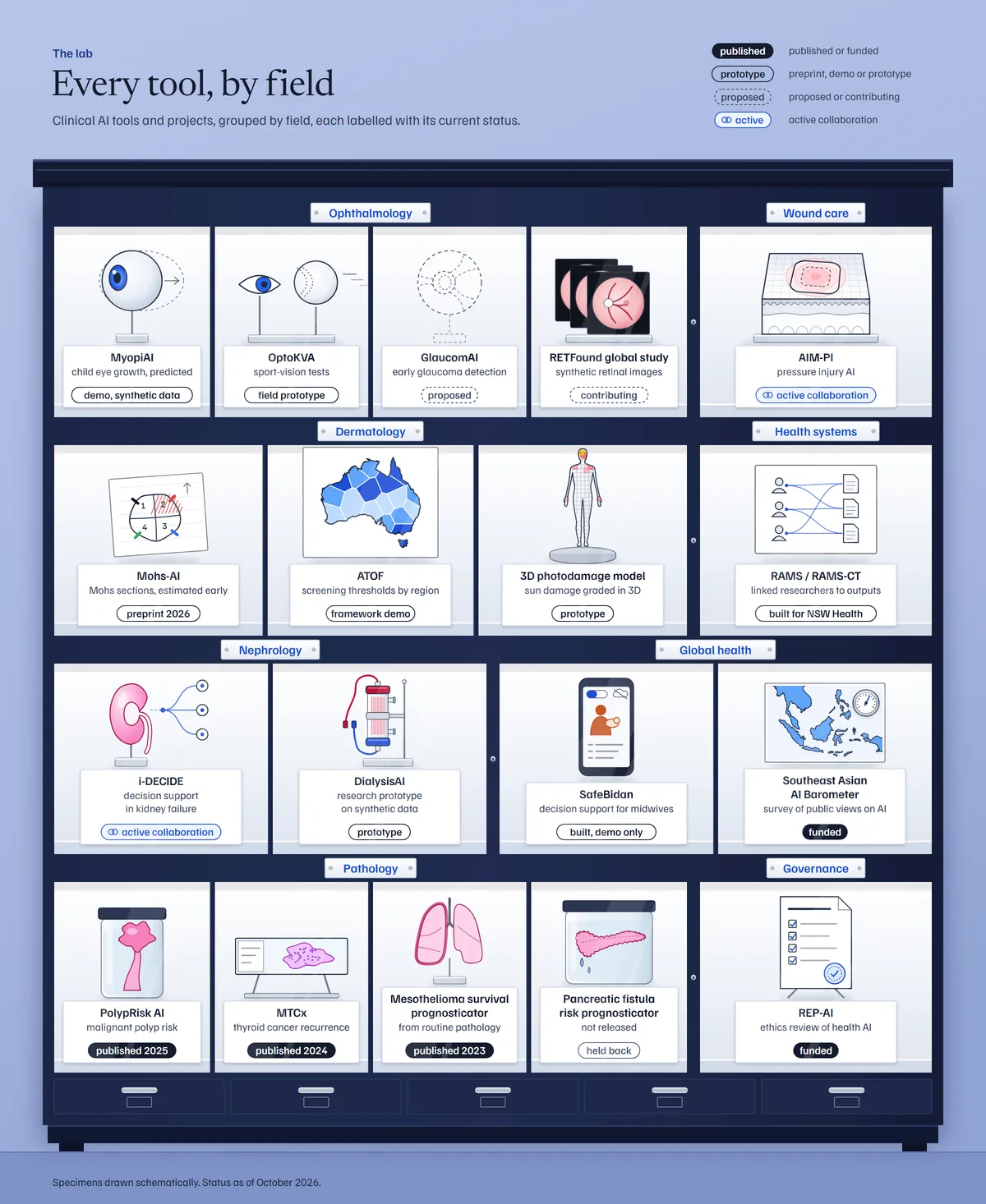
The lab, illustrated. Every object is described below the picture.The lab, illustrated. Every object is described below the picture.

Move across the picture to look closer. On a phone, tap to place the lens.

Ophthalmology

MyopiAI, a platform of Acuity Intelligence, is designed to predict how a child's eyes will grow; it runs as a demonstration on a synthetic cohort and has not been clinically validated. OptoKVA is a browser-based sport-vision test battery, a field prototype that has not been validated. GlaucomAI, for the early detection of glaucoma, is proposed and not yet built, and I contribute, through the Westmead Institute for Medical Research, to the RETFound global study on synthetic retinal images.

Everything in this room

Ophthalmology
MyopiAI, a platform of Acuity Intelligence, is designed to predict how a child's eyes will grow; it runs as a demonstration on a synthetic cohort and has not been clinically validated. OptoKVA is a browser-based sport-vision test battery, a field prototype that has not been validated. GlaucomAI, for the early detection of glaucoma, is proposed and not yet built, and I contribute, through the Westmead Institute for Medical Research, to the RETFound global study on synthetic retinal images.MyopiAI: demonstration platform
Wound care
AIM-PI is an active collaboration on AI for hospital-acquired pressure injury, led from Sydney Local Health District. I am its AI and machine learning clinical lead. A critical review of pressure-injury prediction models is in preparation.
Dermatology
Mohs-AI is a research model that estimates, before surgery, which cases are likely to need 13 or more Mohs sections. I am first author of the Mohs-AI preprint, which has not been peer reviewed; its external validation is planned. ATOF is a framework for setting melanoma screening thresholds region by region, and its demonstration tool shows illustrative values. The 3D photodamage model grades sun damage in three dimensions; it is a research prototype and not a diagnostic device.Mohs-AI: medRxiv (preprint), 2026ATOF: demonstration tool
Health systems
RAMS and RAMS-CT were research-intelligence platforms that I designed and built for NSW Health. RAMS linked researchers to their publications and grants across institutions, and RAMS-CT extended the same approach to clinical trials.
Nephrology
I lead the AI in i-DECIDE, an active collaboration between Australian and Swiss university hospitals on decision support for people with kidney failure choosing between dialysis, transplantation and conservative care. DialysisAI is a research prototype on synthetic data for haemodialysis anaemia decision support, developed with the renal unit at Royal North Shore Hospital; it is not a clinical tool and has not been validated.
Global health
SafeBidan is AI decision support for midwives caring for mothers and newborns in Indonesia; it has been built and demonstrated on synthetic data, and has not been deployed in clinical care. I am a co-investigator on the Southeast Asian AI Barometer, a survey of public views on AI in five countries, led by colleagues at the University of Sydney and funded by the Sydney Southeast Asia Centre.
Pathology
With pathologists and surgeons I built three published prognostic models, all free research calculators and not part of routine care: PolypRisk AI for malignant polyp risk, MTCx for thyroid cancer recurrence, and the Mesothelioma survival prognosticator, which works from routine pathology. MTCx was developed with 300 patients from five centres in four countries and validated externally in 87 patients at Emory University, with an AUC of 0.90. A fourth, the Pancreatic fistula risk prognosticator, is held back and not released: it was developed on a small cohort from a single source and stays a research prototype until it is validated in a larger, independent cohort.PolypRisk AI: ANZ Journal of Surgery, 2025PolypRisk AI: calculatorMTCx: Histopathology, 2024MTCx: calculatorMesothelioma survival prognosticator: Pathology, 2023Mesothelioma survival prognosticator: calculator
Governance
REP-AI is a $2.25M NHMRC Partnership project on the ethical review of health-AI research. I am one of its chief investigators. The project is administered by the University of Wollongong.

In the picture

Ophthalmology

MyopiAI
child eye growth, predicted
demo, synthetic data
OptoKVA
sport-vision tests
field prototype
GlaucomAI
early glaucoma detection
proposed
RETFound global study
synthetic retinal images
contributing

Wound care

AIM-PI
pressure injury AI
active collaboration

Dermatology

Mohs-AI
Mohs sections, estimated early
preprint 2026
ATOF
screening thresholds by region
framework demo
3D photodamage model
sun damage graded in 3D
prototype

Health systems

RAMS / RAMS-CT
linked researchers to outputs
built for NSW Health

Nephrology

i-DECIDE
decision support in kidney failure
active collaboration
DialysisAI
research prototype on synthetic data
prototype

Global health

SafeBidan
decision support for midwives
built, demo only
Southeast Asian AI Barometer
survey of public views on AI
funded

Pathology

PolypRisk AI
malignant polyp risk
published 2025
MTCx
thyroid cancer recurrence
published 2024
Mesothelioma survival prognosticator
from routine pathology
published 2023
Pancreatic fistula risk prognosticator
not released
held back

Governance

REP-AI
ethics review of health AI
funded

Title

The lab
Every tool, by field
Clinical AI tools and projects, grouped by field, each labelled with its current status.

Legend

published
published or funded
prototype
preprint, demo or prototype
proposed
proposed or contributing
active
active collaboration

Specimens drawn schematically. Status as of October 2026.